BEGIN YOUR HOME-BUYING JOURNEY WITH SHANNON
Historic Portland Homes vs. a New Build: What Actually Ages Better?
Explore the evolution of Portland homes from the early 1900s to the postwar era. Discover how materials used in homebuilding reflect long-term durability and the shift towards modern construction techniques.
Shannon McLaughlin
5/14/20266 min read
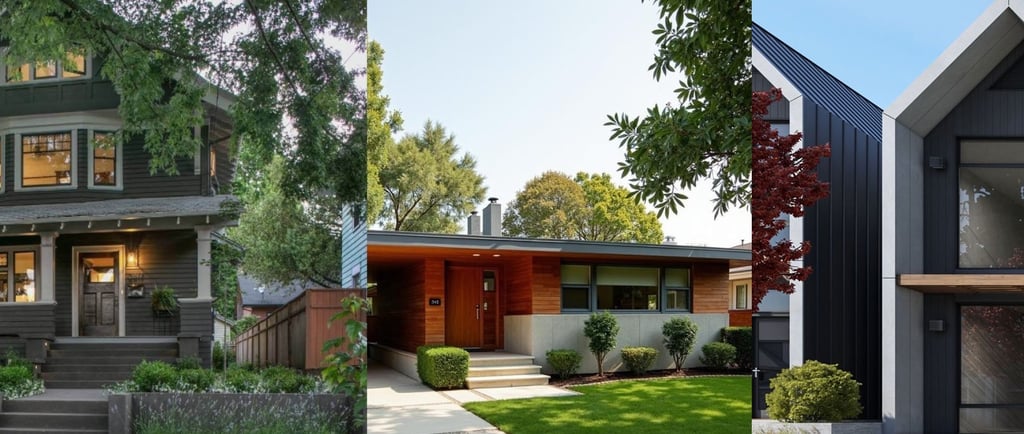
HISTORIC Portland HomeS vs. a New Build: What Actually Ages Better?
When people compare older Portland homes with new construction, the conversation usually goes something like this: old homes have charm, but they’re “a lot of work,” and new homes are clean, efficient, and easier to live with.
That’s not wrong. But it’s also not the full picture.
Homes built in the early 1900s and before weren’t just “earlier versions” of modern houses. They came out of a completely different material and construction mindset — one shaped by local resources, slower building practices, and a very different expectation of how a house should age over time.
And once you start to see that, the differences stop feeling cosmetic and start feeling structural.
The early 1900s: when homes were built from SOLID, NATURAL material
If you step into a 1910 or 1920s Portland home, one of the first things you notice — even if you don’t immediately name it — is density.
Not just visual density, but material density.
Floors are thick old-growth hardwood, often fir or oak, that can be refinished multiple times without losing integrity. Trim isn’t applied decoration — it’s solid wood with depth, often milled locally and installed as part of the framing logic of the house. Doors are heavy in your hand. Windows were built with real wood and glass that can be repaired rather than replaced.
Even the walls tend to feel different. Many of these homes used plaster over lath, which creates a wall system that feels more solid and acoustically “quiet” than modern drywall assemblies.
The key difference here is that these materials were not designed around speed or disposability. They were designed around longevity and repair. If something wore out, the expectation wasn’t replacement of the entire system — it was maintenance of the original material.
The World Wars: the beginning of “building for efficiency”
The shift away from old school styles of building didn't happen all at once. It happened gradually, and the World Wars are a major turning point.
During World War I and especially World War II, construction materials and labor were redirected toward the war effort. Homebuilding slowed, then restarted under pressure — and that pressure changed how things were built.
After WWII, there was a massive housing demand almost overnight. That’s when you see efficiency starting to matter just as much as craftsmanship.
You still see wood framing and solid construction in this era, but the priorities begin to shift:
houses are built faster
details are simplified
floor plans become more standardized
materials start being chosen for availability and speed, not just longevity
This is really the beginning of homes becoming more “systems-based” rather than “craft-based.”
The postwar 1940s–1950s: still solid, but noticeably simplified
Homes from the late 40s and 50s are interesting because they sit right at the transition point.
Structurally, they’re still very good. You’ll still see real hardwood floors, solid framing, and materials that have held up surprisingly well. A lot of these homes are still incredibly livable today.
But compared to earlier homes, things start to flatten out visually and materially.
Frank Lloyd Wright was designing through this entire period, and in some ways he was already pushing architecture toward simpler lines and less ornamentation. But his version of simplification was intentional — rooted in craft, proportion, and custom-built materials, not based in the need to produce homes to keep up with demand.
Trim profiles during this time became thinner and simpler. Built-ins became less common or less detailed. Cabinetry started shifting toward early manufactured systems instead of fully site-built millwork. You can feel the beginnings of a more industrial approach to residential construction.
The house still has substance — but typically less of the layered craftsmanship that defined earlier decades.
It’s the point where homes start to feel less like individually crafted objects and more like repeatable models.
Then modern construction changeD the material language entirely
Fast forward to today, and the biggest shift isn’t just aesthetic — it’s material philosophy.
Modern homes are incredibly strong in terms of systems. Energy efficiency is better, insulation is better, mechanical systems are far more advanced, and building codes have significantly improved safety and performance.
But the visible and touchable materials inside the home are often very different from what you see in early 20th-century construction.
Instead of solid wood trim, you often see MDF or composite materials. Instead of plaster walls, drywall becomes universal. Instead of solid hardwood in every application, you’ll see engineered flooring or laminate. Cabinetry is frequently modular and mass-produced.
These materials are not “bad” — they are just optimized for a different set of priorities: cost control, consistency, and ease of installation.
The tradeoff is in how they age.
Because solid wood can be refinished and restored, while many manufactured materials are designed to be replaced once they wear.
How that difference actually shows up over time
This is where the contrast becomes very real.
Older homes from the 1900s–1950s tend to age in layers. Floors get refinished. Trim gets repainted. Kitchens get updated. Systems get modernized. But the core structure stays intact underneath all of that.
It creates a sense of continuity — like the house is accumulating history rather than cycling through resets.
Newer homes often age differently. Because so many finishes are part of integrated systems, wear tends to show up in clusters. Floors, cabinetry, fixtures — things start to reach their lifespan at similar times, which leads to larger replacement cycles rather than incremental restoration.
So instead of the home feeling like it’s deepening over time, it can start to feel like it’s being periodically refreshed.
There’s also something less technical that people notice immediately
This is harder to quantify, but it’s often the thing people respond to first.
Older homes tend to feel more grounded spatially. Rooms are more defined. Materials are heavier. Surfaces have texture and variation. Even imperfections — slight unevenness in floors, variations in wood grain, original glass — contribute to a sense that the space has depth.
Newer homes often prioritize openness and uniformity. That can feel very clean and functional, but sometimes less layered. Less visually “anchored.”
It’s the difference between a space that feels composed over time versus a space that feels designed all at once.
So what actually ages better?
It depends on how you define “better.”
Homes built in the early 1900s through the 1950s tend to age better in terms of materials you can repair, detail that deepens over time, and a sense of continuity as the house evolves.
Modern homes tend to age better in systems — efficiency, safety, and early-life maintenance ease.
But the deeper distinction is this: Older homes were built in a world where a house was expected to be maintained indefinitely. Newer homes are built in a world where parts of a house are expected to be replaced over time.
And that difference shapes everything — not just how they age, but how they feel to live in.
The interesting part, especially in Portland
Portland was founded in the mid-1800s, but the neighborhoods people recognize today were built in distinct waves from the early 1900s through the postwar era — and you can still see those layers in the housing stock.
The first big wave came with streetcar expansion in the late 1800s and early 1900s. That’s when Portland grew outward into neighborhoods like Irvington, Alameda, Laurelhurst, and Ladd’s Addition. These areas reflect the Craftsman, Tudor, and Foursquare era — old-growth lumber, detailed millwork, and a strong emphasis on craftsmanship and permanence.
After World War II, everything shifted. A massive housing shortage, returning veterans, and GI Bill financing drove rapid expansion, and the city pushed outward into large-scale subdivisions built for speed and volume. In Northeast, this shows up in Parkrose, Hazelwood, Roseway, and parts of Madison South and Sumner. In Southeast, it expands into Brentwood-Darlington, Lents, Powellhurst-Gilbert, and edges of Montavilla and South Tabor, where ranch homes became the dominant form.
From the late 20th century onward, much of Portland’s growth shows up as infill — new homes built into existing neighborhoods rather than whole new subdivisions, shaped by zoning, energy codes, and rising land values.
So when you move through Portland, you’re not just seeing different architectural styles — you’re moving through chapters of how the city physically expanded: streetcar-era craftsmanship, postwar suburban growth, and modern infill all sitting within the same urban fabric.
And once you start noticing it, the comparison shifts. It stops being about which home is “better,” and becomes more personal: whether you want a home that accumulates character through repair and time, or one that stays consistent until it eventually cycles into renewal.
Portland is one of the few cities where building history is still visibly layered in real time. You can walk a single block and move through completely different eras of how homes were imagined and built.


I’m a HISTORIC HOME LOVER
I’ve developed a deep appreciation for the historic homes that give Portland neighborhoods their character. There’s something special about the craftsmanship, the details you don’t see in newer builds. I live in my own little historic bungalow and love the feeling of being connected to a rich history. Questions about historic homes? I’m your girl.
THRIVE PORTLAND
Helping you navigate the wild world of real estate.
CONTACT
STAY IN THE LOOP
+1 (971) 412-2410 text/call
© 2026. All rights reserved.
Thrive Portland, LLC is licensed in the state of Oregon.
Shannon McLaughlin
Licensed Oregon Realtor®
Managing broker



2601 NE Glisan Street
Portland, Oregon 97232
@THRIVEPORTLAND